A well-designed conveyor system is what keeps a plant moving: it connects every stage of the process, sets the production rhythm and removes the manual handling that creates downtime and risk.
What is an industrial conveyor system?
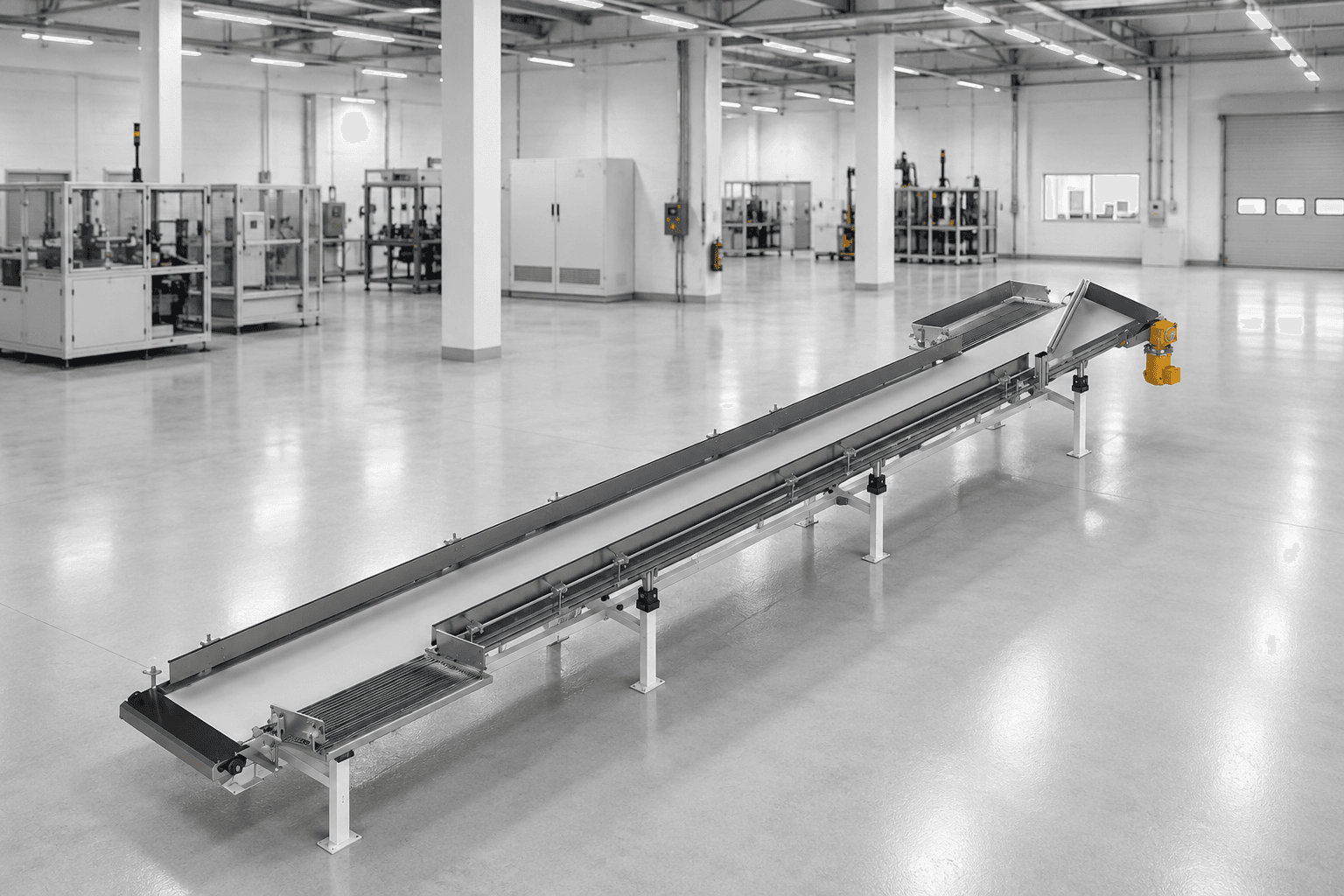
A conveyor system is the set of elements that moves materials, parts or products from one point to another automatically and under control. Belts, rollers, chains or modular systems work together to sustain a continuous flow.
Beyond transport itself, a good system synchronizes stations, regulates the line's pace and connects processes that would otherwise depend on the manual movement of materials.
Types of conveyor systems
The conveyor type depends on the product and the process: belts for small or bulk parts, rollers for boxes and pallets, modular plastic conveyors for curves and washdown, and chains for heavy loads.
In many cases the solution combines several types, integrating lifts, diverters and accumulators to solve level changes, sorting and buffering between stations.
Logistics planned as a whole
Designing a conveyor system is not just choosing a belt: it means studying material flow, cycle times, ergonomics and the plant layout as one whole.
That is why the project starts early, with the concept and a feasibility study, to ensure the system fits the available space and the real production rhythm.
Key benefits
Continuous flow
Connects stations and removes manual movement between processes.
Controlled pace
Synchronizes cycle times and regulates the line's speed.
Lower risk
Reduces manual load handling and the associated ergonomic risks.
Traceability
Allows sensors and control to be integrated to track material along the line.
Applications
- Assembly lines
- Packaging and end of line
- Box and pallet handling
- Station feeding
- Sorting and diverting
- Level changes between processes
Frequently asked questions
Which conveyor type does my process need?+
It depends on the product, the weight and the path. Belts for small parts, rollers for boxes and pallets, modular for curves and washdown, chains for heavy loads. Usually several are combined per section.
Can it integrate with my existing equipment?+
Yes. Systems are designed to connect with stations, robots and already-installed equipment, synchronizing cycle times and control signals.
Do you include the feasibility study?+
The project starts with the concept and a feasibility study that validates the flow, the available space and the production rhythm before manufacturing.